
Circular Meetings
A Guide for Leaders and Participants

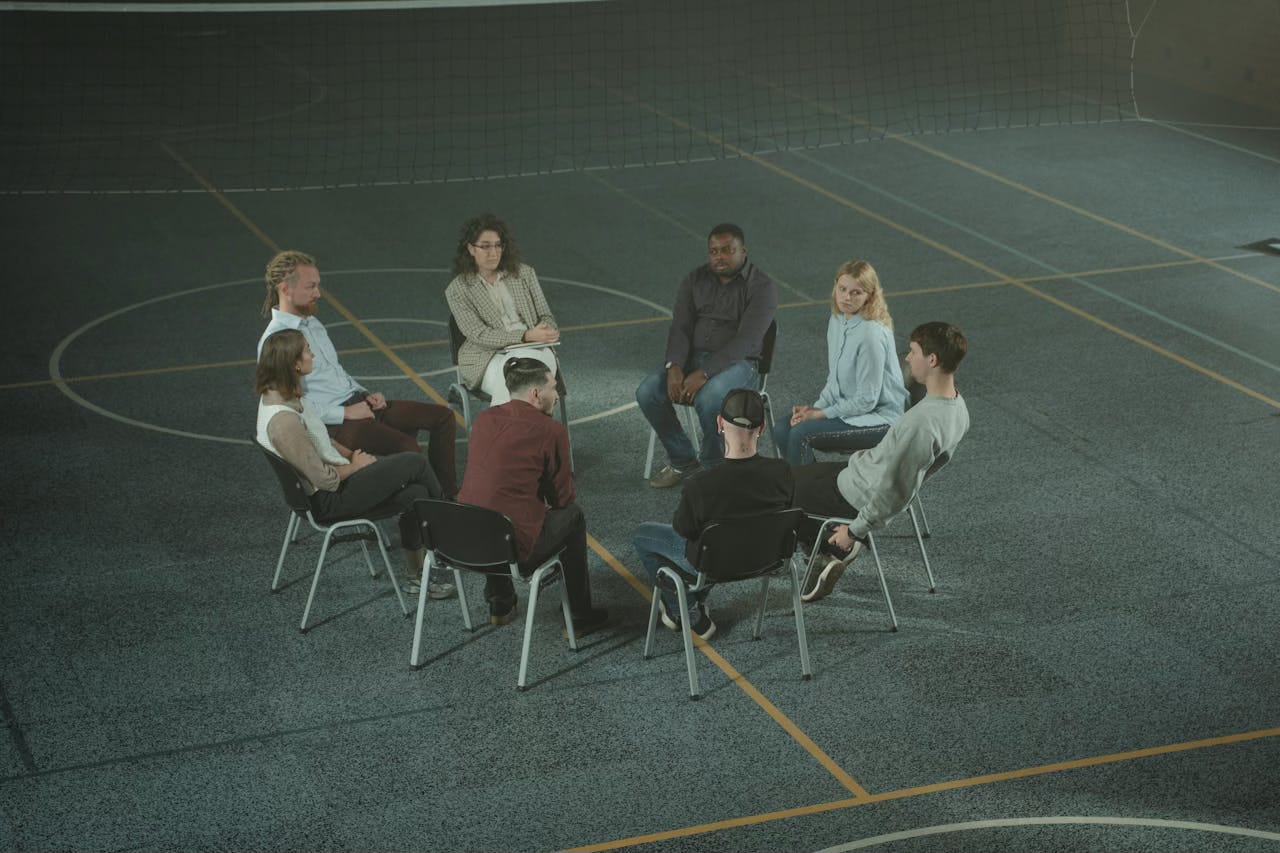
Holding a meeting while sitting in a circle doesn’t mean you’re having a circular meeting. That would require a shift in mindset from linear to circular thinking, while sitting in a circle. Sometimes we really want to be in a circular meeting because it brings the benefits of relationship development, creative problem solving, discovery of what is meaningful to the group, and resilience. And that’s not even a full list.
Relationship Development
When a group of people have a feeling of connection to each other, they listen to understand what the other person has to say. They also offer a willingness to be changed by what they hear. The listener is predisposed to find places where they can say yes, and together they search and stretch to expand their overlapping interests. When surprises arise, people with good relationships pick up the phone to sort it out, and choose not to assume there was mal-intent. In these ways, a group becomes more resilient each time they regroup in a circular mindset.
The key is to find out how to make a connection with people in a meeting format. There have actually been experiments conducted to answer this question. Arthur Aron, a professor of psychology at the State University of New York studies intimacy. In his lab, he observes how two strangers can develop a sense of closeness. He needed a way to measure closeness so he invented the Fast Friends Procedure based on studies of what makes people feel close. He narrowed it down to four principles.
1. Self-disclosure: share something of yourself, but not too personal, and not too fast;
2. Back and Forth: ensure a balance of talking, listening, and being responsive to what the other person said;
3. Send Signals of What You Like in the Other Person: signals like smiling or voicing authentic interest in what a person is saying signals that it’s a safe place to be vulnerable; and
4. Find Similarities: highlight something you have in common.
Starting a Circular Meeting
Before people even arrive, the host of a circular meeting takes care of the environment. The location needs to offer beauty to nurture the soul, like nature , or good architecture do. Nourishing and delicious food, including attention to people’s individual needs, also goes a long way towards creating a welcoming space. In an austere space I like to add flowers, candles, or some surprise element that offers an easy conversation starter. And of course, the seats are arranged to so everyone can look into each other’s faces.
After everyone arrives and has had some time to eat and mingle, the host invites them to have a seat. Participants are welcomed with expressions of gratitude, and statements to ensure everyone is comfortable and has free will such as “please get water or coffee when you need it. If it comes to your time and you find you don’t want to speak yet, say that, and we will be glad that you feel comfortable being authentic with us.” Statements like this begin to establish a judgement free zone.
The host then begins the introductory round by describing a bit of what is happening in their world. The key is to share something personal but not too personal. It should also be of a length that shows respect for the need for all participants to have a turn.
As a host, I begin with a pause to listen to my inner voice and choose one or two things to share. I have shared how excited I am to introduce this process, and grateful for people willing to participate despite it being unfamiliar; how much I am looking forward to hearing people’s thoughts on the subject we have gathered around. I’ve talked about what brought me to be interested in this subject. For example, “for me, I have been interested ever since I worked in a bush camp in northern BC as a junior geologist. I loved the feeling of being connected to nature”. Sometimes I share a sensation that I’m having like “right now all I can think of is the smell of those wonderful cinnamon buns. Thank you to the people who brought those. They remind me of a welcome pleasure in my days as a student at UBC”. This signals that this is a space where we can be human.
Then I look to my left, my heart direction, signalling to the next person that they have the space to speak. Person by person everyone gets a chance to hold the space and share something of themself, knowing they won’t be interrupted or challenged.
The host judges if the group is ready for a break when the round is complete. It usually depends on how much people choose to share.
If someone needed to speak longer than most, the host signals understanding with focused attention or a nod. This creates a good example of prioritizing open listening or progress. It often takes people a few sentences of circling around the thing a person really needs to say before the best words come to them, especially in the early days.
Notice there is no stated goal for the meeting, no agreed upon agenda items, and there will be no progress reports or to-do items assigned at the end. These are all hallmarks of a linear meeting, and we aren’t in Kansas anymore, Toto.
The importance of breaks
In a circular meeting, breaks are as important as time spent in the circle. The host provides a container for the break with a statement of when to reconvene. It gives people a chance to find that person they discovered they have something in common with during the introductory round and start a conversation. If someone has expressed discomfort, another person might want to go over and say that they can relate. A person might know of information that would be of interest to one of the other participants and go over and share it. The breaks are opportunities for spontaneous connections. It is also a chance for people who need some alone-time to recharge themselves and return in a comfortable state. And if there is a burning email, this is a chance to answer it so you can give your full attention back to the meeting.
These are the relationship practices that are going to ensure easy flow of information between meetings. Authentic sharing will happen quickly during difficult times, and when new opportunities arise.
Round Two
When the host is again sitting with the group in a circle, a question is posed for each member to consider. The nature of the question keeps people in a circular mindset. It needs to be an open question that gives language to bigger values, with lots of room for personal opinion. Examples of questions include:
What makes your work meaningful to you?
What values do we want to further through this project?
What does good communication look like?
What does good leadership look like?
I like to have paper and pen in front of each participant for this round, and I encourage them to write down what someone said that they want to add to, or rang true for them, or lead to a personal inspiration. Writing it down frees us from thinking of nothing but trying to remember. Once the thought is written down we can continue to listen to what the speaker is saying.
When I start the round, if something confuses me, I share that. It shows that we don’t have to have an agenda, know the answers, or be clever. Sometimes a genuine question leads to the unspoken parts that were causing problems. It’s this kind of authenticity that is going to get us moving towards group wisdom. Also, one person’s vulnerability becomes contagious and more people start sharing openly.
Conclusion
I finish the meeting with an opportunity for free-flowing conversation while still in the circle where everyone can benefit. People can talk spontaneously, or if there is lots of excitement, I introduce a talking stick or stone for people to pass around and signal which person holds the floor. The lack of note-taking makes people feel free to try-out a thought and allow the group to help develop it.
In a final closing round, people each have an opportunity to share how the process was for them, what they learned, or how they are feeling now.
The Time Between Meetings
The lack of assigned tasks at the end is important. It beckons people to take the initiative to further the parts of the discussion that inspired them.
Another benefit people notice is that they have an increased ability to make decisions with consideration of how it will impact other people. Members also know how to support each other, or shape their project to make it easier for a spin-off business to find its place.
The meeting has created closeness between people, provided an arena for practicing a new set of skills, and planted a lot of seeds that can be followed up by interested parties in the between times. The spontaneous formation of these side groups is foundational to the success of new ideas.
And thus the knights of the round table !